
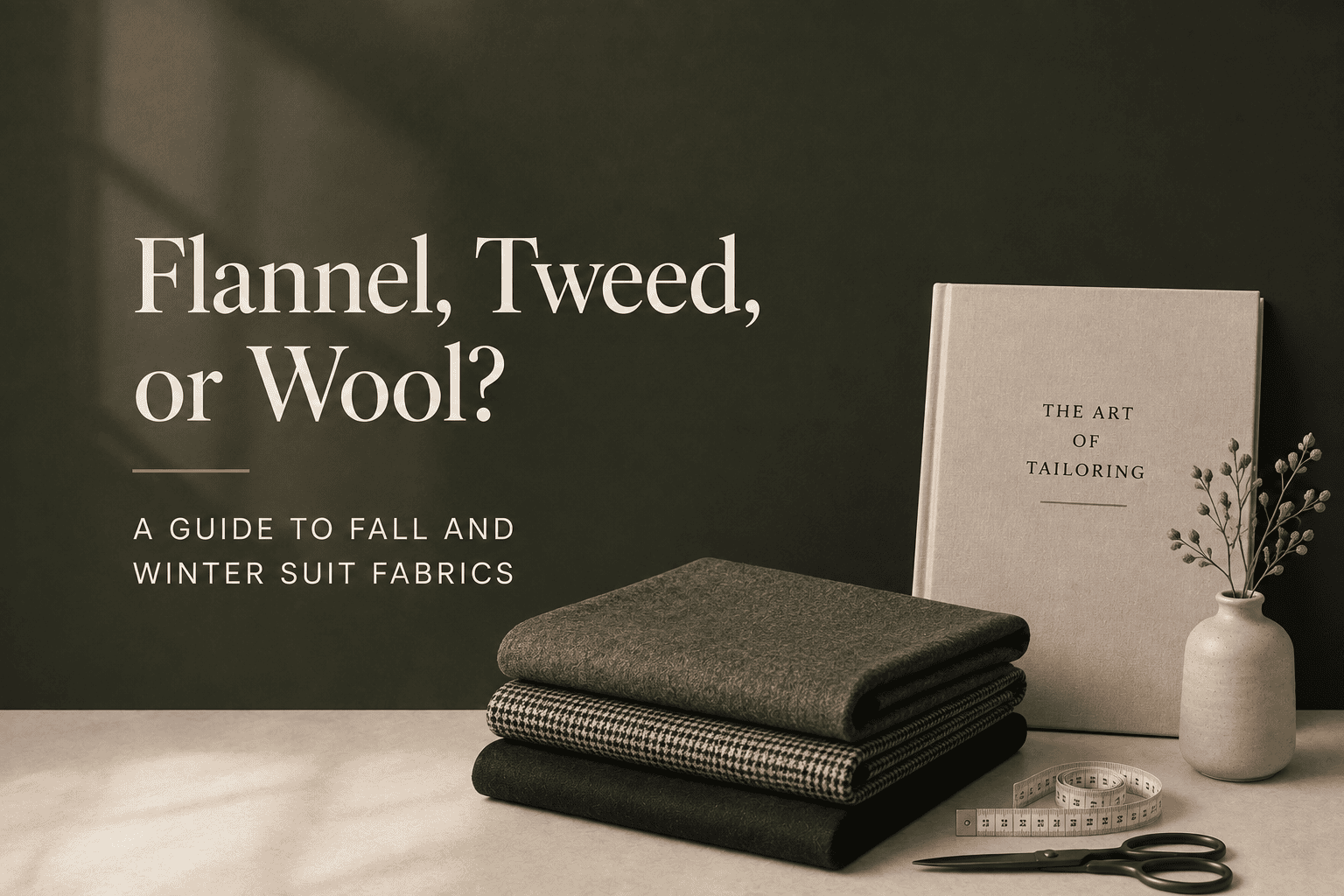
Most people choose cold-weather cloth by name and get it wrong. Tweed sounds warm, flannel sounds soft, and neither tells you what you actually need to know. The useful question is weight, finish, and where you will be wearing it — a heated office and an outdoor November wedding are not the same climate, even in the same week.
Start With Weight, Not Name
Suiting is measured in grams per metre. Anything under 260g is a summer cloth. From 280 to 330g you are in three-season territory, which is where most New York suits should live. Above 340g is genuinely winter cloth — warm outdoors, punishing on a heated subway platform. If you commute, err lighter than instinct suggests and let your overcoat do the work.
Worsted Wool: The Winterized Workhorse
A worsted is smooth-finished, tightly spun, and holds a crease. In a heavier weight it becomes a legitimate winter suit that still looks correct in a boardroom. If you are buying one cold-weather custom suit and it has to cover work, funerals, and holiday events, this is it — in charcoal or navy, around 320g.
Flannel: The Fabric That Reads as Fall
Flannel is a woollen cloth with a brushed, slightly napped surface that diffuses light instead of reflecting it. That softness is why grey flannel photographs so well and why it feels dressier than its formality suggests. It is warmer than a worsted of the same weight and it does bag slightly at the knee through a long day — press it, rest it, and it recovers. Mid-grey flannel is one of the most useful suits you can own.
Tweed: Texture With a Time and Place
Tweed is coarse, irregular, and built for weather. It is excellent for odd jackets, country weddings, and weekends, and it is almost always wrong for corporate Manhattan. If you want tweed in a suit, keep the pattern quiet — a herringbone or a subtle Donegal — and accept that it is a Saturday garment that occasionally goes to work, not the reverse.
Cashmere and Wool Blends: Warmth Without Bulk
A 10 to 20 per cent cashmere blend adds softness and warmth without much extra weight, and the hand is immediately noticeable. The trade-off is durability: cashmere pills and wears faster at friction points. It is a good choice for a second or third winter suit, or for a blazer you will wear carefully. It is a poor choice for the suit you wear three days a week.
Corduroy and Moleskin: The Off-Duty Options
Both are cotton, both are warm, and both have quietly returned. A corduroy jacket in tobacco or olive is a genuinely useful autumn garment; a full corduroy suit is a strong style position that not everyone wants to take. Moleskin trousers are the underrated pick — warmer than wool flannel, tougher, and they read casual without reading sloppy.
What Actually Works for a New York Winter
Layer strategy beats fabric weight. A 300 to 320g suit, a proper overcoat, and a fine-gauge knit under the jacket will outperform a 400g suit worn alone, and you will not overheat the moment you step indoors. Buy the suit for the room you will be in, and the coat for the street. If you are choosing cloth for a wedding specifically, our guide to wedding suit fabrics covers that separately.
Why New Yorkers Choose Bespoke Ensemble
- A fabric library spanning English, Italian, and French mills
- Cloth you can handle in person before committing
- Full and half-canvas construction made in-house
- Guidance on weight and season, not just colour
- Midtown Manhattan atelier, minutes from Grand Central
Book Your Private Consultation
Bespoke Ensemble — 315 Madison Avenue, 20th Floor, New York, NY 10017. Call +1 212-920-5474 or book a complimentary consultation online. First-time clients receive $100 off their first order.