
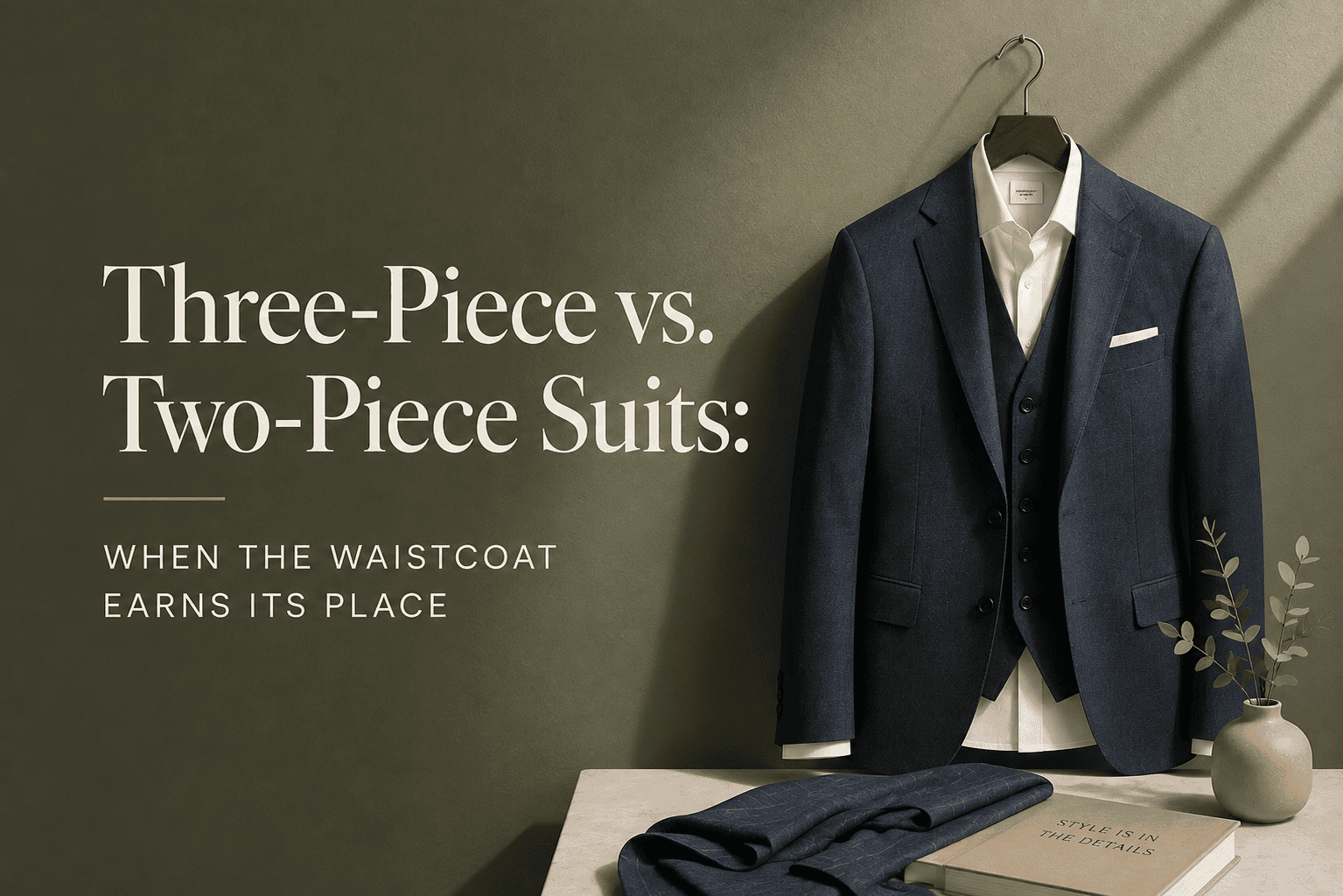
The three-piece has been quietly returning for several seasons now, mostly through weddings, and with it a familiar mistake: adding a waistcoat because it looks more formal rather than because it does anything. A waistcoat is a functional garment with a specific job. When that job matches the occasion, it is the best thing in your wardrobe. When it does not, it reads as costume.
What Actually Separates the Two
A two-piece is jacket and trousers. A three-piece adds a matching waistcoat cut from the same cloth. That is the whole technical difference — but the effect is disproportionate, because the waistcoat covers the shirt, closes the front of the torso, and changes what happens when you take the jacket off.
When a Waistcoat Earns Its Place
Three situations, mainly. First, when you will remove your jacket and still need to look dressed — a long reception, a full day of meetings, a summer wedding where the jacket comes off after the ceremony. Second, when you want visual formality without going black tie: a three-piece in charcoal or midnight sits comfortably above a two-piece and below a tuxedo, a distinction we cover in our guide to suits versus tuxedos. Third, when you are the groom and want to read differently from a room full of men in two-piece navy.
When It Works Against You
Skip it in genuine heat — a waistcoat is a third layer, and no fabric fully solves that. Skip it if you are broad through the middle, unless your tailor cuts it properly; a poorly fitted waistcoat exaggerates exactly what it is meant to smooth. And skip it for business-casual environments, where it tips from sharp into theatrical.
The Fit Rules Nobody Tells You
A waistcoat should cover the waistband of your trousers completely — no shirt showing between the two, standing or seated. It should sit close enough that it does not balloon when you button the jacket, without pulling at the buttons. The bottom button stays undone. And the back should be cut in the same cloth if you will ever remove the jacket in public; satin backing is a cost-saving convention, not a style choice.
Fabric and Season Matter More Than Formality
Flannel, tweed, and mid-weight worsteds carry a waistcoat well from October through March. Fresco and high-twist wools make a summer three-piece survivable. Linen almost never does. If you are commissioning for a specific date, choose the cloth weight for that month first and decide on the waistcoat second.
The Three-Piece as a Wardrobe Multiplier
This is the underrated argument. One three-piece gives you a full suit, a two-piece suit, a waistcoat with odd trousers, and a jacket-and-trouser combination — four looks from one commission. For anyone building a working wardrobe rather than dressing for a single event, that arithmetic is hard to beat, and it is why we often suggest it for a client’s second or third custom suit rather than their first.
Why New Yorkers Choose Bespoke Ensemble
- Waistcoats cut from the same cloth, front and back, as standard
- Full and half-canvas construction, made in-house
- Multiple fittings before the garment is finished, as set out in our bespoke process
- Published pricing with no upsell theater
- Midtown atelier minutes from Grand Central
Book Your Private Consultation
Bespoke Ensemble — 315 Madison Avenue, 20th Floor, New York, NY 10017. Call +1 212-920-5474 or book a complimentary consultation online. First-time clients receive $100 off their first order.